Showing posts with label feminism. Show all posts

Monday, 4 August 2014

Why Lily Allen's 'Hard Out Here' single backfired as a feminist message.

Before I get started, I want to make it clear that I am, in fact, a massive fan of Lily Allen. Despite the ideas I am going to discuss regarding her thwarted attempt to create a feminist message using the song Hard Out Here and its accompanying music video, I do really like Allen, both as a person and a singer. I recognize that, although misguided, her attempt to communicate a feminist message is still a positive step, even if this time it unfortunately failed.

It is important to first address the creepy elephant in the room - I'm looking at you, Robin Thicke. Allen makes no attempt to hide the fact that Hard Out Here is a response to the contentious singer's debut single Blurred Lines, featuring Pharrell. We cannot discuss one without the other, so I will briefly describe the infamous debacle that followed Thicke's emergence into the popular music industry. For those who had their eyes and ears shut for the majority of 2013, Blurred Lines was a single which raised the hackles of many feminists and rape survivors. The message behind the lyrics was clear - consent is not a black and white issue but a subjective and ambiguous animal. Let me say that this is irrefutably incorrect. The woman in the song is either giving her permission to be engaged with sexually, or she is not. There are no two ways of looking at consent - either it is present or absent. In its absence, the woman should be shown nothing short of respect and space. Lyrics such as "I know you want it" (rape victims often hear this by their abusers as a means of self-affirmation) demonstrate his idiocy and ignorance of a sensitive topic. Taking advantage of the fact that sexual abuse is not treated with the seriousness it deserves by the legal system and the eye of society, Thicke has ridden on the back of discrimination against women and their sexual autonomy with a view of making himself money. And we, as a society, made him filthy rich.
http://thehairpin.com/wp-content/uploads/2013/11/lily-thicke.jpg

The video for Blurred Lines featured messages in the background (behind the girls in underwear dancing with the married father of one) such as "ROBIN THICKE HAS A BIG DICK". This self-celebration of his alleged manhood, and the power this apparently gives him, does much to demonstrate the patriarchal society we are subjected to live within today.
In retaliation, Allen's Hard Out Here video features balloons spelling "LILY ALLEN HAS A BAGGY PUSSY". No doubt a comment to the ridiculousness of Thicke's video, this may be the only part of the video I like. Her unashamed, tongue-in-cheek manner of portraying herself further identifies her as 'unfeminine' (according to the traits we as a society assign femininity: i.e. meekness, demureness, chastity, innocence, polite acquiescence, obedience), for she is loud and confident when screaming about her 'undesirable' womanhood.

Further than this, her lyrics aim to take a swipe at the misogynistic pop culture that has worsened during her (self-imposed) musical hiatus. Allen encourages us to "forget your balls and grow a pair of tits / it's hard, it's hard, it's hard out here for a bitch". The use of the word 'bitch' here is a reclamation of the term, to free it from it's intended insulting connotations and instead becomes something to be used with pride. However, not all of her lyrics encompass the feminist message. "You'll find me in the studio / and not in the kitchen" is probably aimed at all the popular jokes surrounding women retiring to the kitchen and fetching their men sandwiches. I can see why she has said it, but I think such lyrics are counter-productive.
http://ignitetheliight.tumblr.com/post/68478477806
For me, the essence of the feminist message has two prongs. The first is that women should be equal to men in all aspects of life; be that religion, politics, freedom, employment, etc. The second is that women should have the freedom of choice over themselves. This encompasses a wide range of things, such as sexuality, employment, marital status, motherhood, appearance, etc. The feminist message I believe in would support a woman if she wanted to be a biochemist as equally as it would support a woman who had made the informed choice to be a stay-at-home mom. Neither choice should be coupled with ridicule, disbelief or discrimination.What Allen is effectively doing with this particular lyric is alienating women who choose to be housewives by making them appear as subordinate to those who choose to pursue careers; she identifies as one such woman. I think that Allen has missed the point somewhere that feminism means equality for all women as all men; not only for some women. I am reminded of a quote by George Orwell, in the literary masterpiece that is Animal Farm; "All animals are equal, but some animals are more equal than others".

Further to this, Allen mocks the misogynistic music videos that men make, and women perpetuate. Her satire is merciless when she approaches media-heavy topics head-on; such as weight (an agent is speaking to her on the operating table and chastising her for her looks, as if aesthetic appeal is more important than the music she has to sell, despite her having had children) and when she is stood in the kitchen, in a seductive outfit and washing up (only instead of a plate, it is assumably her male partner's car rims).
As she says herself, "I don't need to shake my arse for you / cos I've got a brain".
This, unfortunately, is pushed to the wayside when her video features some women 'twerking' in very little clothing and pouring water all over eachother. I assume it can only be meant as a sarcastic parody, but the slow motion shots of women's backsides jiggling in time to her music indicates otherwise. Perhaps the only way Allen thought she could make men receive her message was by luring them in using the sex appeal of some young women? If I was a self-respecting male, I would be outrageously insulted by such an assumption.

http://static.entertainmentwise.com/photos/Image/13LilyAllen3.jpg
As a white female, I feel that I am ill-equipped and too uneducated to really discuss my next issue, but I feel I must raise it. Her scantily-dressed dancers were of black and Asian descent, leaving herself as the only white female in the centre of the choreography. Allen claims that only the best dancers were hired, race was not an issue, and she only refrained from twerking herself, despite trying during rehearsals, due to insecurities (source). This may be so, but the finished product speaks for itself.


In essence, I think that Allen has tried to make a statement that feminism is still alive, if not a little overlooked, and although "sometimes it's hard to find the words to say / [she'll] go ahead and say them anyway". For that, we should be grateful because, although this attempt may have missed its mark by miles, at least she's trying.

Thursday, 26 June 2014

Valley of the Dolls by Jacqueline Susann: Review and Feminist Insight.

Valley of the Dolls is a Hollywood thrill-ride from start to finish and, as commentator Julie Birchill posits, is ‘the most fun you can have without a prescription!’

Author Jacqueline Susann took her chances at the American Dream by trying, and failing, to become an actress. Susann’s subsequent seen-it-all attitude became the base note for writing a thick novel in the style of a gossip column, in which she intricately weaves the debaucherous exploits of her three heroines. It is fantastically rumoured that Valley of the Dolls was written on a hot-pink typewriter.
Susann when young
Not that Anne, Jennifer or Neely are particularly concerned about the traditional ideals of what it means to be 'feminine' in 1940s America. Femininity in this cultural and time sphere has connotations of demureness, chastity, maternity, obedience, beauty and innocence. All but Anne are unconcerned about the (society-created) disadvantages of losing their virginity, and Anne, the anti-Venus, is labelled 'frigid' and worries that there is something wrong with her.
The character of Jennifer North, too, is completely against what the patriarchal standards of femininity believe to be 'normal'. We learn, from her first third person perspective within the book, that she was involved in a lesbian relationship with a girl named Maria for several years, who divided her time between an innocent friendship role and sexual deviant. Maria not only initiated the sexual acts with Jennifer, but taught Jennifer how to explore and enjoy her own body. This is something Jennifer very much keeps to herself throughout the rest of the novel; potentially through fear of what her other friends would say. 

 Set in the 1940-1960s, the reader follows the strive for glittering stardom with our ingĂ©nue protagonists Anne Welle (secretary-turned-model), Jennifer North (all-American beauty), and Neely O'Hara (hot-headed actress). The novel follows their journey from the savage fight to kick start their careers in the most world-coveted setting, where thirst for fame and fortune plagues the teens’ minds. Watching washed-up stars like Helen Lawson fall from grace only encourages them, as the girls are determined to avoid her mistakes.

However, the pressure of fame, screen tests and sexuality can be very daunting. The ‘dolls’ referred to in the title are a metaphor for prescription drugs and uppers; little red, yellow and green pills which tranquilize, energize and down-size the girls.

The cut-throat nature of the agency business means that friendships are brought to their limit; after all, there is only room for one at the top. Moral qualities such as loyalty, chivalry and honesty are thrown to the wind in this dog-eat-dog world of Susann’s lavish creation.

More than just a fast-paced swipe at the media industry, Valley of the Dolls is essentially a feminist novel. If you are to take one message from it, let it be the one she screams at you: “Guys will leave you… your looks will go, your kids will grow up and leave you and everything you thought was great will go sour; all you can really count on is yourself and your talent”.


The character of Helen Lawson is the complete antithesis of what it means to be feminine. She is loud, abrasive, arrogant, sexually available and selfish. However, this apparent lack of consideration for all others around her is essentially the key which brings her much success and happiness. Albeit rather alone at the top, she is at the top and ensures that all of her (self-centred) dreams come true.

  Jennifer is also notorious for her 'European' films where she appears in many roles completely naked; an artistic vision which the other girls label brazen and condemn her for. Femininity places a strong emphasis on a girl's need and want to become a mother. We learn that Jennifer has seven abortions; the ultimate abhorrent act of disinterest towards the 'natural' mothering instincts she should possess. Her carefree attitude towards the abortions, as a medical inconvenience rather than any source of moral, philosophical or religious turmoil, further isolates Jennifer as deviant from the ideals of motherhood and, in turn, femininity. 
  The ultimate betrayal of the patriarchy, and probably the biggest feminist comment made by Susann in the whole novel, comes when Jennifer commits suicide. Before the final act, Jennifer is inches away from the happiness she has so eagerly sought her whole life. She is to be married to a Senator who, through the nature of their meeting and falling in love, convinces Jennifer he loves her for the person she is inside rather than the body so popular with cinema fans. When it is uncovered that Jennifer has breast cancer and is to undergo a mastectomy, her Republican husband-to-be enthuses about how much he cares for her breasts because they are in essence herself and he could not stand anything happening to them. This pushes Jennifer to silence and, after sneaking out of the hospital and home, overdoses on her dolls to leave the perfect embalment of the perfect body.

The reliance on stimulants for comfort has been likened to little girls clutching their dolls. Furthering the feminist theme, Susann’s, albeit subtle and implicit, use of the word ‘dolls’ could symbolise the treatment the girls receive by their male counterparts in patriarchal America.
  With the creation of the television an ever-present threat and husbands becoming notoriously hard to hold onto, the search for happiness, and the discovery of what ‘happiness’ even means, for each girl becomes more and more difficult.


Addiction, ageing and (medical) affliction are inherent concerns for Susann. Unexpected twists and gruesome ends; this book is exhilarating and incredibly difficult to put down. If Carlsberg made novels about glamorous Hollywood hyperreality…

Tuesday, 27 May 2014

Elliot Rodger's 'Retribution': An Internalised Misogynistic Perception of Entitlement to Women's Bodies.

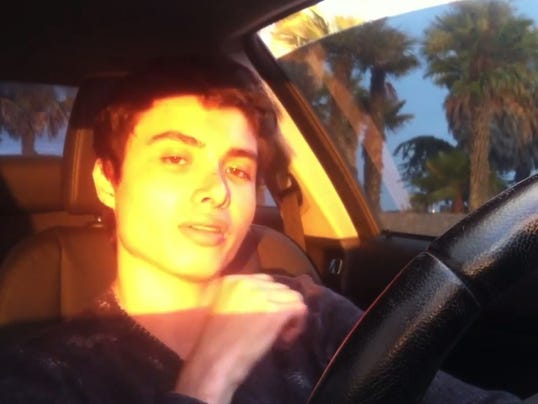
Elliot Rodger has shot to fame after posting his story, 'My Twisted World' and various videos on YouTube about his 'retribution' of all the girls, by whom he felt his sexual advances were wrongfully rejected, so much so that it was 'criminal' and an 'injustice', and all the boys whose sexual prowess made Rodger desire a life in which he was similar.

Photo credit: www.usatoday.com
Despite his parents' concern over his deteriorating behaviour and visits by the police, who found him to be a shy and well-mannered boy, the long-term Asperger's sufferer was deemed to be a non-threat. This non-threat then successfully shot and killed 6 people in a student-based California town; his main aim a Sorority house filled with 'spoilt, blonde sluts', before ending his own life.

This triggered a worldwide response to Rodger's inherent hatred of women, and the tag #YesAllWomen began trending on social media platform Twitter, where women by their hundreds and thousands tweeted of their own experiences with misogyny and how it left them feeling. 

Whilst focus has been placed on the NRA, US politics concerning gun control and better support systems for those with mental illnesses, as well it should, I think the emphasis due on worldwide misogyny has been misplaced. Whilst a sufferer of Asperger's Syndrome; not all people with the same disease commit such felonies. Similarly, not all people who have the same innate hatred of women are sufferers of Asperger's, or in fact any mental, disease.

The self-confessed root of Rodger's anger against women (and sexually successful men) stems from the belief that he is entitled to the enjoyment of women's bodies for sexual performance. Although he briefly mentions his want for love from women and companionship from his fellow students, particularly, he highlights, during his college years, the manner in which he speaks in a YouTube video filmed in a Cali car park dictates a sense of authority and ownership over women. When Rodger is denied such ownership, when his sexual advances are rejected, he views this failure as a denial of his rights and so views it as 'criminal'. The way in which Rodger describes his fellow students' success with women is that the women are, as is their duty, giving their bodies for his classmates to enjoy; rather than any sense of autonomy or agency on the part of the female.

This is a symptom of a worldwide internalised misogyny, where in the modern day patriarchal society, the sense of superiority over women and sense of dominance over the 'lesser' gender has become the norm. 
Gender is a concept primarily constructed by culture and history. It is a qualitative construct of socio-legal meanings we attach to certain attributes and characteristics of bodies. This process of attaching meaning to bodies is the acceptance of gender-specific norms and behaviours; subscription to which indicates conformity with the hegemonizing form of social control that gender offers. Feminist theorist Butler asserts that biological essentialism can be disputed because although sex is determined by biology, gender is culturally-constructed. The very definition of woman as 'woman' is, as Moi posits, defined by men who, in turn, view the world through a patriarchal perspective. Women are paternalistically assigned their place in society by men (de Beauviour).

When Rodger's attempts of sexual encounters with women (where, as a cisgender heterosexual body, his intercourse would include the submission of the female) are rejected and he fails to achieve the heightened sense of dominance, he is left feeling lonely and confused. This sense of isolation, coupled with a misguided perception of entitlement to the women's body, and any sexual services they may provide him, resulted in such a strong misogynistic anger that he committed the acts he did.

Rodger displays a belief system based on contradicting ideologies which is typical of the misogynist. Women, both as a gendered body and to perform their gender, require possession of conflicting attributes to be accepted by society. Relevant examples of these include chastity, loyalty, innocence and obedience, alongside provocativeness and the ability to sexually please (a male). These realistically cannot all sit complementary within one gendered body, yet misogynistic spheres of society still hold high this expectation. Rodger condemns the girls as 'sluts', thereby having lost their desired sense of innocence. However, he repeatedly admits displeasure over their ability to please other men sexually, acts which he covets for himself, and through no sense of innocence can girls learn how to do this.

Rodger regards the women as 'spoilt'. To be spoilt, women would have to be under a sense of ownership; presumably here he is referring to money and gifts received from parents. However, isn't owning women and having them obey to his sexual fantasies precisely what Rodger desires? Isn't the denial of such a desire the premier reason his anger grew?

This distorted sense of womanhood, and what womanhood should mean for men, is symptomatic of a modern patriarchal society where the internalised misogynistic perspective of what it means to be feminine is possessed by almost all men and, unfortunately, some women. This upsetting fact means that the dislike of, and sense of superiority over, womankind has become so normalised over time that women view themselves as a sub-species without even realising they are doing it.

Nev Schulman, hit MTV show Catfish host, made a post on Facebook regarding the shootings and, although briefly mentioning hatred for women as a growing social issue, focused his (long) statement on how we could better progress as a society by inclusion and preventing the sense of isolation Rodger felt. Excuse me? Although I agree fundamentally that those suffering from mental distress should have better communication channels to facilitate their rehabilitation, it must be acknowledged that the ONLY cause of this tragedy is Rodger's anger towards women. Instead of feeling pity for the lonely underdog, we should feel a sense of anger that men of today feel so entitled to women's bodies that when they are denied it, they feel it only right that they can take life, to force compliance out of women. What about the families who have just lost their daughters? Women who, Rodger admits, have done nothing personally to him - they were just innocent bystanders; a front for all womankind, against whom Rodger directed his anger. 
Rodger's victims.
Photo credit: www.independent.co.uk
Yes, Nev, "[w]e ALL want to be accepted and feel desired". However, you do not possess the right to be desired. You are not entitled to women's love, body or sex. Nev's statement, although of some merit, has little credibility because it is written from a male-privileged perspective; which is precisely the problem I have been trying to illustrate throughout this article.

Instead of encouraging people, namely women, to reach out and make the stereotypical loner feel wanted and sexually-desired, how about encouraging men to respect women and their autonomy? How about educating men that women are not objects to be dominated or owned, but that they are animals of free-will and if they do not find you sexually or romantically attractive, then tough. Get over it. Dealing with rejection and loneliness is an aspect of every single person's life; women or men. No one has the right to own another person or to restrict their autonomy. The longer we view sexual engagements as ownership over women's bodies; the longer this problem will continue.